On the Calculation of Volume (Book I)
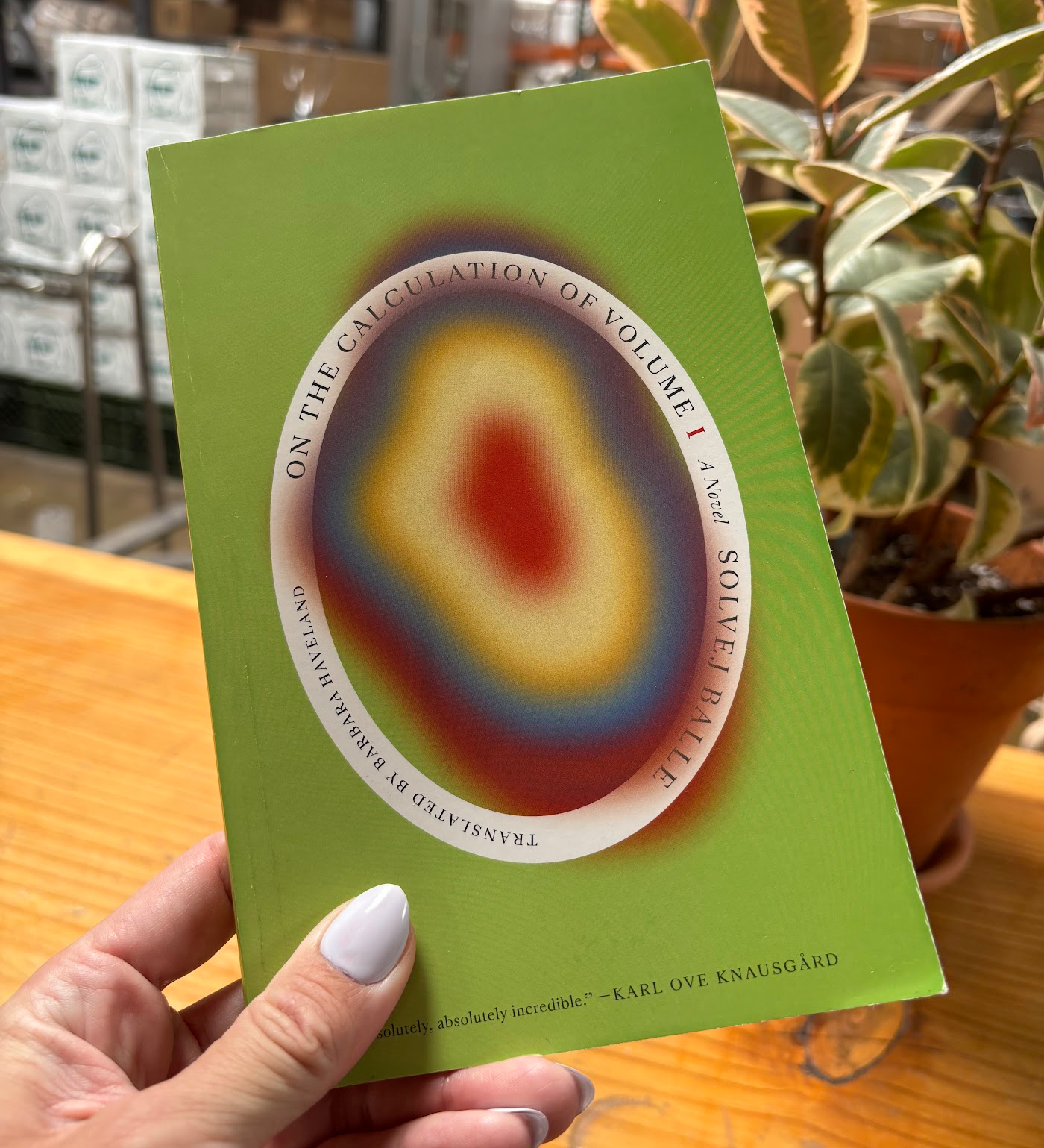
Spoilers below.
On the surface, Solvej Balle's On the Calculation of Volume could be a genre novel—many race to reference Groundhog Day in the first sentence of their reflection. To me, it was a meditation on what happens when the markers we use to reason no longer work.
Tara Selter is an antiquarian book dealer whose job is to see that things reach their rightful place: she travels to bid on rare books and in turn, like a tock for her tick, her husband Thomas sends them to collectors. Her daily life is portrayed with dispassion; she herself is a sorting mechanism for space that is propelled by the progression of time. It is on a business trip when time falls apart, and she begins to encounter the same day over and over again. With her propellant gone, she turns to meticulously accounting for the objects around her, using them to wayfind through time and space.
She returns home to Thomas, informing him of the predicament from scratch each iteration. For a while, there is a devil-may-care exuberance of experiencing love unbounded by the passing of time: they joke, go for walks, eat, make love, and run experiments to debug the loop. Soon, though, the exuberance runs out, and ironically, Tara begins to feel temporally distant from Thomas. Each day that passes, each iteration, leaves Tara with a subjectivity that has moved on, while Thomas' has not. It is here she decides to proceed alone, moving into a guest room within her own house.
In the guest room she lives according to her husband's rhythm, now the tock for his tick, studying the sounds Thomas makes as he moves through the house, timing her life to his so as not to be discovered while being nearby. Here she begins solitary acts of orientation: like a sailor, she procures a telescope to view the night sky. It is also here she begins the diary through which the reader comes to know her. The text of On the Calculation of Volume is that record: the exhaust she leaves behind, the clues for her future self, as if a subjectivity-based dead reckoning.
I've seated myself by the window. In front of me is a little pile of papers on which it says that there's someone in the house and that I can hear him moving around. I've written that he's waiting and that he's waiting for me. I've written that time has fallen apart. I'm getting used to the thought. I've written that I'm getting used to the thought and that there is healing in sentences. Maybe. 24
A wayfinding instrument that only grows in importance for Tara as the same day passes by:
I don't know what is going on. Whether time is switched off at night, whether past and future disappear during slumber and are not invoked again until one wakes. Or whether it is the words that are erased, leaving only the outlines of things. Maybe it is language that shuts down, so one wakes up wordless or with words only for the most immediate concepts: morning, now, here, awake, light. Maybe one wakes without sentences. Or with the simplest sentences, which unfold as one wakes up. Now it is morning. Here is a day. I am awake. 52
I found the book oddly calming; watching Tara grasp for markers made my own struggles to find mine feel less lonely. I was left wondering: what are my fruitless rituals of reorientation? And what are the pleasures of being disoriented?